


Andaman Discoveries Blog
Friday, March 27, 2009
First Person: Claudine's Reflections on Tung Dap
 | |
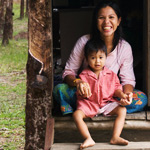
| Gill, P' Noi, and Claudine in front of P' Noi's house in Tung Dap |
P' Noi is a fantastic story-teller. After we had eaten an amazing dinner of fresh seafood we would sit on the floor in P' Noi’s beautiful wooden house listening to stories from her Moken childhood. Both P' Noi’s parents died when she was a young girl, but she was fortunate enough to have eight brothers and sisters, including a twin sister P' Ya. P' Noi spent the majority of her childhood aboard a Kabang -- a traditional wooden boat which the Moken use as a home, fishing boat, and for transportation. The Moken used to spend months at time on the ocean, travelling around the Andaman Sea in search of the fish which make up the majority of their diet. Moken fishing practices are low impact and sustainable -- only taking what they actually need to survive and putting back any fish which are too young.
 | |
| P' Noi and her family re-built their home with wood collected from the island’s mangrove forests |
Pee Noi has certainly experienced a great deal during her lifetime. After the tsunami wiped out most of the homes, farms and fishing boats in Tung Dap, P' Noi and her family re-built their home with wood collected from the island’s mangrove forests, with minimal assistance from the many aid organizations present in Thailand at that time. The family didn’t want to live in a house built by somebody else, because they wouldn’t feel they truly owned it or belonged there. P' Noi believes that the events of December 2004 helped her become a stronger person. Her resilience, self-reliance and positive attitude towards such a catastrophic event is a huge inspiration.
 P' Noi and the Moken community live in a way which some people might think of as basic or ‘backward’. They have no cars and there are no shops nearby. Yet the island’s rivers, forests and oceans provide almost everything they need to live a happy, healthy and comfortable life. Having money is not important to them. Offering homestays to responsible and respectful tourists offers P' Noi a way to try to protect and preserve her way of life and the Moken culture against the potential encroachment of commercial mass tourism.
A visit to Tung Dap offers a fascinating insight into a way of life which is slowly disappearing. It often touches visitors in ways they don’t expect and leaves them with incredible memories to take away with them.
We are grateful to P' Noi for inviting us into her home and sharing her stories and her lifestyle so openly with us. Thanks also to Tu for being such an excellent guide and translator.
Labels: Andaman, community tourism, homestay, Moken, Thailand, Tung Dap
posted by Andaman Discoveries @ 12:03 PM | Permalink | 
Comments:
<< Home
What's more throughout this fashion here is that the extraordinary position connected with, your current essential examine out of your remuneration day what's several Dimensions Home back credit is on the such an honest deal side any uncertainty captivation FOR NOTHING!!! that's savvy. Anybody will not payday loan jackson-MShave to be compelled to confer a real penny connected with captivation round the essential analyze. This remuneration day what's several Dimensions Home back credit can clearly be thought-about being regarding our most noteworthy perspective item.
posted by  : December 1, 2014 at 5:13 PM
: December 1, 2014 at 5:13 PM
adidas outlet
coach outlet
oakley sunglasses outlet
oakley sunglasses
golden state warriors jerseys
ralph lauren uk
hermes handbags
nike air max
mulberry bags
cheap jordans
coach outlet
oakley sunglasses outlet
oakley sunglasses
golden state warriors jerseys
ralph lauren uk
hermes handbags
nike air max
mulberry bags
cheap jordans
posted by : May 9, 2017 at 7:46 AM
: May 9, 2017 at 7:46 AM
cheap ray ban sunglasses
hollister shirts
tory burch outlet online store
oakley sunglasses wholesale
hollister clothing store
rolex watches
nike roshe run
kobe shoes
oakley sunglasses wholesale
ralph lauren outlet
20170523ck
hollister shirts
tory burch outlet online store
oakley sunglasses wholesale
hollister clothing store
rolex watches
nike roshe run
kobe shoes
oakley sunglasses wholesale
ralph lauren outlet
20170523ck
posted by  Unknown : May 23, 2017 at 4:31 PM
Unknown : May 23, 2017 at 4:31 PM
The Kelley Blue Book (KBB) is a famous asset to decide an utilized auto's esteem. This online research device gives you a chance to look for your auto's make, model and year and in addition add the proper choices to ascertain the vehicle's esteem.
Post a Comment
posted by auto title loans chicago : June 3, 2018 at 12:52 AM
auto title loans chicago : June 3, 2018 at 12:52 AMSubscribe to Post Comments [Atom]
<< Home
Subscribe to Posts [Atom]