


Andaman Discoveries Blog
Monday, July 13, 2009
Learning about Elephants
 Experiences in Thailand
By Leslie Welshimer
Eager visitors flock to Thailand to experience the country’s welcoming people, stunning scenery, appetizing cuisine and the chance to get up close with an elephant (Chang in Thai).
In choosing where to spend time with elephants, it was important to me to choose an organization that was ethical and truly helping elephants. I’d read rave reviews about the Elephant Nature Park near Chiang Mai, so after some investigation, I booked the “Learning Elephant” day tour.
The Elephant Nature Park is a sanctuary and rescue centre for about 30 elephants. It’s located in a breathtaking valley. The park is bordered by a river and encircled by forested mountains in Chiang Mai province.

Being in the presence of elephants was humbling and mesmerizing. We were given a sizable bucket full of bananas, corn and squash to feed one elephant. The elephant looked at us with kind eyes and gently took food from our hands.
After feeding, we had some downtime to relax and watch the elephants stroll about the park. I would have been happy to just sit and watch them for hours. The interaction in activities, like feeding and bathing, was just icing on the cake.
The bathing was one of our favorite parts, as we had the opportunity to wade in the water and immerse with the elephants. Buckets and brushes were distributed to volunteers and guests to split the duties.
The lunch that we were provided was astounding. It was a full buffet of 20+ options. The feast would leave even the most selective eater with a beaming smile and full belly.

There was an educational element woven throughout the day’s events, including about an hour where we watched a documentary about Asian elephants. The documentary was powerful, eye opening and inspired us to want to help.
The memorable day concluded with transport back to our guesthouse. Our exceptional guide, Chet, gave us a chat about how people can make a difference and concluded by saying, “Take care of your health and your love. Make the world smile.”
If you’re interested in visiting the Elephant Nature Park, click here to learn more.
Labels: Elephants, Thai culture, Thailand

Wednesday, July 1, 2009
Community-Based Tourism Pilot Tour: The Real Value of a Home
It’s hard to explain what makes a home inviting and exude warmth. Is it the comfy sofa, the pictures on the wall, or a manicured lawn?
I believe that people create the feel of a place (okay, so architecture is a big player too, but if you fill the most beautiful building in the world with grumps, it’s not going to be a fun place).
Have you ever walked into a work place, and felt tension so thick, you could cut it with a knife? No one is talking, but yet you feel the emotion of the people.
 |
| Ban Lion Village |
Ban Lion showed me what makes a place. The people, with genuine warmth in their eyes, a smile and the kindness to share their lives made their residences inviting, not the homes lined up like an Excel spreadsheet.
Our destination for a two-day pilot tour in June was Ban Lion, a village located on the northwest side of Koh Prathong in Phang Nga Province. The residents are a collective of people from different villages who were affected by the tsunami in 2004. The homes in the village were built with the support of Lions Club International.
We were greeted while unloading from the boat. I was instantly impressed that the villagers came to us, versus waiting for us to come to them.
The home style in Ban Lion likely contrasts the image of Thai homes most foreigners have in their heads. My first thought upon arrival was, “Am I in an American suburb?” Completely identical homes are in clean, distinct lines.
Any confusion I had was replaced and trumped ten-fold by the people. They were so determined to make us feel at home. Our homestay hosts were two, 20-year-old girls, who work at the nearby Golden Buddha Beach Resort.
The first day we explored sea grass at low tide where pools were full of more star fish than I’d ever seen at once. We visited the old village, called Pak Jok. The tsunami devastated Pak Jok Village, leaving only small sections of concrete road and the bases of a few buildings. From there, we walked to the beach for sunset.
 |
| Sun Dew Plant |
On day two, we took a short tractor ride to the golden grass fields. Our energetic guides’ passion for the area was contagious. They took special care to point out each detail. My favorite plant was the sun dew, which has a trap for insects to fall into to provide the plant with nutrients.
There was a brief discussion at the end of the tour where we gave our feedback on everything from the food to activities. My overall feedback was that it’s the seemingly small stuff that makes a tour, a restaurant, a hotel or the world work. Life is all about the difference between someone pointing down the street, when you’re new in town and ask where post office is, versus someone walking you there and buying you a cup of coffee.
-Leslie Welshimer
Labels: community tourism, homestay, Thai culture, Thailand, Thailand homestay
Friday, June 26, 2009
A different kind of guide book: Travelers’ Tales Thailand
Experiences in Thailand
By Leslie Welshimer
Traveling to unfamiliar places can be daunting or delightful. Getting answers to important questions in advance increases the odds that one won’t miss out on amazing experiences or unknowingly offend someone.
 Before visiting a new place, I’ve found it to be immensely helpful to read and study up on topics like the culture, geography, local holidays and weather. Otherwise, you may travel six hours to visit a place, like the Surin Islands, only to learn it’s closed for the rainy season.
I came to Thailand in February 2009. In an effort to minimize my footprint on the Thai culture, I was determined to gain as much of an understanding as possible of Thailand. My goal was to arm myself with an arsenal of literature to educate myself before departure and along the way. I made a pact to only read books related to Thailand while in the country.
 When I departed Seattle, my luggage contained four books:
- A History of Thailand by Chris Baker and Pasuk Phongpaichit
- Buddhism for Beginners by Thubten Chodron
- Lonely Planet Thailand guidebook
There was a fifth book I wanted before departure, but I was unable to secure it. Luck was in my favor because in March, the Hoyt family visited Andaman Discoveries. The family came with the book, Travelers’ Tales Thailand, edited by James O'Reilly and Larry Habegger. The Hoyts were finished reading the book and asked if anyone would like it. I raised my hand like an anxious grade school kid at a chance for a cupcake.
Travelers’ Tales Thailand is a Lowell Thomas Award Winner - Best Travel Book. It is a series of short stories or excerpts from complete books by highly regarded authors like Pico Iyer, Diane Summers and Jeff Greenwald.
I finished Travelers’ Tales Thailand in May. It provided an overview of Thailand with entertaining personal stories. The book reminded me a bit of the Chicken Soup for the Soul Series, but targeted at travelers.
It made the perfect book, as I could pick it up and read one story or more if I wanted. My only regret is that I didn’t read it before I departed Seattle. It contained enlightening tidbits about the essence of Thailand that would have helped shape my expectations beforehand.
Travelers' Tales has more than 100 titles in print. I plan to make it a tradition to see if there is a Travelers’ Tales book available on future travels.
What’s next on my Thailand-immersion reading list? Kelly May loaned me her copies of, Culture Shock: Thailand (Culture Shock! A Survival Guide to Customs & Etiquette) by Robert Cooper and Nanthapa Cooper, and Letters from Thailand, by Botan and translated by Susan Fulop Kepner.
What is your favorite Thailand-related book? If there is a book that you recommend for Thailand travelers, please feel free to comment on the blog or contact us to share your thoughts.
Labels: Kelly May, Thai culture, Thailand
Tuesday, June 16, 2009
In the Spotlight
National Geographic recommends Andaman Discoveries
 The third edition of the award-winning “National Geographic Traveler: Thailand” hit bookshelves recently, and the current version recommends Andaman Discoveries for responsible tourism in Thailand. Guidebooks are an important way of sharing information with travelers, and we are grateful for another opportunity to shine light on responsible tourism.
In addition to the National Geographic guidebook, Andaman Discoveries is featured in the Rough Guide, Lonely Planet, Natural Guide, and Beach Huts in Thailand (Denmark). We're also part of the responsibletravel.com network, as well as the Conservation International Community-Based Tourism Program, which supports and promotes community-based tourism ventures that offer significant conservation and development benefits to local communities.
Labels: Andaman Discoveries, guidebook, National Geographic, responsible tourism, Thailand
Drafting the Next Chapter
Team Andaman Looks Inward and Onward
 An unexamined life is not worth living, said Socrates more than two millennia ago, and, like life itself, the complexities of community development and conservation also require an introspective spirit. With that in mind, Andaman Discoveries dedicated the entire last weekend of May to a working staff retreat.
Teamwork was the common goal, from the opening icebreaker in which everyone bunched together in a circle, then bent down and attempted to walk as one, to a finale of “Twister!” For the two days in-between the team worked as one, reviewing the Andaman Discoveries’ mission statement, organizational chart, and everyone’s individual contributions, with fresh feedback and ideas. The retreat was intense at times, as everyone delved deep into planning and direction. But with expert facilitation from seasoned veteran and friend Bill Tuffin, a firm team commitment, and a common vision of future viability, amorphous ideas crystallized into firm plans and clearer roles.
 The retreat was held in Khao Sok National Park at Our Jungle House, which is nestled amongst 25 acres of idyllic lush rainforest bordering the Sok River and soaring limestone cliffs. This was the natural choice for the retreat due to its peaceful setting, open working space, environmental philosophy, and proximity to Kuraburi.
As anyone familiar with Andaman Discoveries knows, we work hard and play even harder, and by late Saturday afternoon serious fun was in order! The team hopped on inner tubes and plunged into the Sok River for a long, relaxing ride. The day’s intensity quickly dissolved in the crystal-clear mountain water. “It was stunning to be floating down a river in an inner tube with the rising moon and limestone cliffs looming above” said Leslie Welshimer.
Those with an insatiable appetite for adventure indulged in an encore trip, and were treated to perhaps the highlight of the weekend. At one point a bamboo shoot cantilevered over the river, on which a family of monkeys was foraging. We silently glided underneath just as the baby leapt through the air onto its mother’s back. Papa meanwhile dangled from the pole while fixing the spellbound tubers with a cautious simian gaze. The poignant encounter with nature was a reminder of why responsible tourism is important, and was one of those magical moments in Thailand that force one to pause and wonder, Is this a dream?
Labels: conservation, jungle, Khao Sok, monkey, Thailand
Tuesday, May 19, 2009
Paradise on Hold …
Surin Islands Close May 15
 Undeterred by the economic downturn, guests from all around the world visited Koh Surin National Park this season. This gem of a park offers snorkeling trips with views of stunning coral reefs. Vibrant marine life joined swimmers splashing in the sea. Visitors escaped in the solitude of breathtaking nature trails. The culture of the Moken people was shared through tours to their village in the islands. Bliss was found in relaxation on the beaches with views of clear, turquoise water.
May 15 marked the end to another memorable season in the Surin Islands. Thank you to all who have made Surin a part of your travels. Andaman Discoveries will be available to help plan your Koh Surin trip next season; the park reopens in mid-November 2009.
Labels: Island Tours, Koh Surin National Park, Thailand
Thursday, May 7, 2009
Responsible Tourism Guide to the Mekong
 Traveling to an unfamiliar place can be daunting, especially for people who aspire to do so ethically. Fortunately the Responsible Tourism Guide to the Mekong helps light the way for travelers visiting Southeast Asia and parts of China. The site includes details on places and activities that will bring life to ones travels while leaving the smallest possible footprint. Andaman Discoveries became their first Thailand entry this month.
One of the major challenges for a small organization like Andaman Discoveries is marketing and promotion – our budget is limited, and we are not priced to compete with mass tourism. We therefore rely heavily on a continued presence in responsible travel websites and guidebooks. This new listing helps spread the word about our tours and volunteer placements, while adding to the list of influential responsible tourism websites that already feature Andaman Discoveries, including responsibletravel.com, the world's leading travel agent for responsible holidays, as well as Wild Asia and the True Travelers Society.
The Responsible Tourism Guide to the Mekong website provides an overview about Cambodia, Laos, Myanmar, Thailand, Vietnam, and the Guangxi and Yunnan provinces of China. In addition, the site includes details on ethical places for hungry travelers to quench their thirst and fill their bellies, unique accommodations to rest their heads and things to do to bring life to ones travels.
For example, when travelers visit two cafes in Cambodia, Café 151 in Phnom Penh and Joe-To-Go in Siem Reap, they are doing more than getting their daily caffeine fix. Profits from the cafes help raise funds for the non-profit organization, The Global Child, which builds and operates specialty schools and safe houses for gifted street children.
The Gibbon Experience, in Laos, offers travelers a chance to rest their heads in the treetops of the Bokeo Nature Reserve. Guests can sleep in tree houses by night and fly through the tree canopies on zip lines by day.
According to the website, it was “inspired by ‘The Guide to Responsible Tourism in Cambodia, Laos and Vietnam’, a publication of the Mekong Tourism Development Project (MTDP). The Guide was funded by the Ministry of Tourism Cambodia, the Lao National Tourism Administration and the Vietnam National Administration of Tourism with loans from the Asian Development Bank (ADB) as part of a MTDP initiative to support sub-regional cooperation for sustainable tourism. The Mekong Tourism Coordinating Office (MTCO) is charged with its distribution and promotion.”
Labels: Southeast Asia, Thailand
Monday, April 20, 2009
Fragile Earth
Getting back to sustainable agriculture
 Monoculture farming is transforming the landscape of rural Thailand. As part of our growing community tourism network, a number of our village partners recently visited northern Thailand, where they learned about the all-too-common shortcomings of monoculture.
The group heard a poignant story from Sud, a small-scale plantation-owner who used to farm cassava root (most famously used in tapioca). For years he struggled to make a livable wage, strained by the high costs of industrial fertilizer and seeds required to sustain this nutrient-intensive crop. After a drought wiped out his crop, he lost everything. Fortunately, training from a local NGO helped redirect his agricultural skills, and he now manages a local community organic farming group. Sud and his group demonstrated how to use bio-fertilizer and employ various organic farming techniques.
The week-long study trip was packed with informative seminars about how to manage sustainable livelihoods and healthy ecosystems. Participants learned about coastal ecosystems, eco-tourism, organic farming, natural resource management, community welfare, and management of foundations and government. The trip provided an opportunity for participants to see models from other communities in the Kuraburi area all the way up to sites in northern Thailand.
Director Tui Chomphrusi represented Andaman Discoveries at the study trip. She remembers a particularly moving and universally-resonant remark from Anan Duangkaewrueng, a former government official turned activist in Chiang Mai: “The answer is not from government, the answer is from community.”
Labels: conservation, monoculture farming, Thailand
Erik’s Journal
Skills for the real world at Phuket Special School
 Since 1993, Phuket Special School has provided a safe and educational haven for disabled, autistic, and deaf children from the ages 6 to 21. Every year, the school hosts a scout camp to develop important life skills and have fun outdoors. We sent Erik Rogers, our creative guru, to join in the festivities:
“It was one of the most enjoyable experiences of my several years in Thailand. I was imdeiately welcomed by the children, who nicknamed me P’ Nung, which translates to ‘older brother number one.’
“The first morning we assembled large tents, dug holes for organic waste, and made dish-drying racks out of bamboo. After lunch, we broke into teams for sports, song, and dance. The evening was equally active, with night-time rope-walking challenges and obstacles courses that would give an army cadet pause. The laughter and song carried on until almost 10 pm.
“I continue to be amazed and inspired by the extraordinary resilience of these young people in the face of very difficult circumstances.”
Labels: disabled children, Phuket, Thailand, volunteering
Legends of the Sea Nomads
Voluntourists treated to stories of Moken culture
 Claudine and Gill (UK) were among Andaman Discoveries’ first voluntourists in Tung Dap village, each enticed by our March special tour offer. Their two-day homestay allowed them participate in and assess several newly-developed cultural activities (and with her nine years’ of experience managing international development projects, Claudine’s feedback was invaluable!). However, the highlight of the trip was homestay host P’ Noi’s evening tales of the seafaring lives the Moken “sea gypsies” -- who comprise about half the village’s population -- were still living a generation ago.
“Perhaps the most enjoyable and memorable part of our stay was listening to the stories of our homestay host, P' Noi. After we had eaten we would sit on the floor in P' Noi’s beautiful wooden house listening to stories from her Moken childhood. P' Noi spent the majority of her childhood aboard a Kabang -- a traditional wooden boat which the Moken use as a home, fishing boat, and for transportation. The Moken used to spend months at time on the ocean, t raveling around the Andaman Sea in search of the fish which made up the majority of their diet.”
You can read Claudine's complete story on our blog. You can learn more about this village on our website, or contact us for details.
Labels: Andaman, homestay, Moken, Thailand, Tung Dap
Kids on Vacation
Family Snapshots from Ban Talae Nok
 The Tausend family (pictured) shared a special reflection about their visit with their two children, ages four and eight:
 “I will never forget the palm weaving activity. We walked up to this older woman's home. She was weaving palms on her front porch and invited us to join her. I was a bit worried about our four-year-old because I didn't know if this was something he would be able to do. The grandma was so patient and helped him the whole time -- with every step. She didn't speak a word of English, but her smile and nods of approval made our son’s face light up several times. What an incredible gift to us as a family, but especially to our little one!”
The Hoyt family had a very different but equally special moment. Their son celebrated his 13th birthday with community members and a delicious cake provided by Andaman Discoveries, and he won’t likely forget the experience of having “Happy Birthday” sung to him by both his parents and his Thai host family! At the end of their homestay the family said, “The people are very gracious, the food is incredible and the children are as friendly as can be. While here, you won’t be looking at Thailand, you will be in Thailand.”
Labels: eco tour, family, homestay, Thailand
Finding “True Thailand”
 A Journey to Muang Kluang Village
Two guests participated in community tours in Muang Kluang in March. For Ruth (Ireland), it was one of the highlights of her Thailand holiday. “We all sat and ate some great food. For me this was the most interesting part of the trip because I felt like I was in true Thailand,” she said. In addition, Ruth enjoyed activities including traditional basket weaving, mangrove tree planting, and a scenic nature hike.
The Muang Klaung homestay program will benefit the villagers through revenue generation that will go towards skills development and youth education. You can learn more about this village on our website, or contact us for details.
Labels: homestay, mangrove planting, Muang Kluang, nature hike, Thailand, traditional basket weaving
Southern Thailand Orphanage
French couple pilot new long-term volunteer opportunity
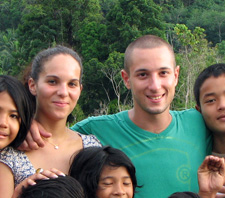 Jeremy and Audrey (France) wanted to spend time with local people and contribute their talents to a worthwhile cause. They found that opportunity through Andaman Discoveries’ newest long-term volunteering program at a southern Thailand orphanage.
During their nine days at the orphanage, Jeremy and Audrey taught the children fun activities like juggling, and also assisted them with gardening, handicrafts, cooking, drawing, and various construction projects. They discovered that even simple acts like smiling and eating with the children provided companionship and support. “The eldest children are really independent, so most of the time we were with the younger ones. They like drawing, singing and listening to us read story books. The children were always ready and happy to do things with us.”
The couple concluded that “it was a wonderful experience. Thank you to Andaman Discoveries for introducing us to the orphanage. We encourage everybody to do the same.” You can learn more about this new program on our website, or contact us for details.
Labels: orphanage, Thailand, tsunami, volunteer, volunteering
Monday, March 30, 2009
Journey to a Border Town
Experiences in Thailand
By Leslie Welshimer
There are many fabulous places for weekend excursions within a few hours of Kuraburi, like Phuket, Khao Lak, Koh Surin National Park (seasonal) and Khao Sok National Park. I ventured out for two days of solo travel in March to explore a town about two hours away from Kuraburi called Ranong. It is a small, border town that has remained mostly untouched by tourist influences.
Ranong is celebrated for its surrounding natural wonders, like hot springs, Ngao National Park, Bald Hill and Ko Phayam and Kam Islands. It’s also frequented by travelers in need of a speedy visa run.
I was greeted by a torrential downpour the moment I got off the bus in Ranong. Turning down offers from motorbike taxis, I walked about 10 minutes into town, determined to get a feel for the area and find lodging before setting out for the day.
Finally I couldn’t take the rain anymore. I was drenched. A tourist office / restaurant appeared and I joined others taking shelter.
Once the rain sort of cleared, I departed the restaurant. There she appeared, a woman with a giant backpack who was speed walking with authority. She didn’t have the clear confusion and lack of bearings that I did. She knew exactly where she was going. I paused for a moment and then doubled my speed to keep up. She was about 20 feet ahead.
 After about 10 minutes I began to consider stopping my stalking attempt. She had turned on to a back road and was walking on a residential street that appeared to be leading out of town. Then she rounded a corner and my breath was taken away. There was Khao Kives View Point, with steps leading up a hillside, and Throne Hall, with immaculate landscaping and ornate temples on the grounds. Across the street from the viewpoint, I saw where she was headed, a guesthouse called Palmy Home.
This guesthouse had just opened three months prior, was in remarkable condition, had new furnishings and a welcoming staff. I never would have found this place with my normal strategies of wandering, asking locals, Google search, reading travel reviews and Lonely Planet. Perhaps stalking is the new Lonely Planet.
I felt like I’d won the travel lottery. My amazing fan room at the Palmy Home was 250 baht / less than $10 for a place significantly nicer than a dozen or so others I’d passed while wandering on my own.
Once lodging was taken care of, I went outside to flag a songtaew (a marriage of a taxi and metro bus). My goal was to reach Bald Hill, which is approximately 13 kilometers away. I got dropped off about 20 minutes later alongside a main highway.
 Due to the moody weather earlier in the day, I found myself hiking around this wide-open Bald Hill area with no one around for a good mile or so, except for a man with an axe in hand.
I paused for a moment, thinking what close friends would think of me walking alone in a foreign country into a mountain area where the only person I could see was a man with an axe. As I approached this man with an axe, I listened to my gut. I felt only peace, so I continued past him and up to the top of Bald Hill. Bald Hill is famous for being naturally treeless, and in non-dry season, is covered in a blanket of grass.

Ngao National Park is within walking distance of Bald Hill. With my hiking shoes of flip flops on, I trekked through the national park to viewpoints, a breathtaking waterfall and checked out their awesome accommodations of a pod-like version of a tree house that tempted me to stay the night, foregoing my earlier find of the Palmy Home.
 The natural beauty of Ngao National Park was overwhelming. The waterfall poured down into a lush forest with bright flowers.
I stopped in the park visitor center to look around. A warm, park staff member said hello and started a conversation. I asked her what the best way to get back to town was, admitting that I had gotten so absorbed in the beauty of nature at the park that I lost track of time. She said I could still flag down a songtaew along the highway. Then she said, “I noticed you came alone. Where are you staying tonight?” I told her and she began speaking Thai to a co-worker.
The woman showed amazing kindness. She said that I could catch a ride with the other staff member who lived in Ranong. I ended up sitting in the back of a pickup, while a husband, wife and their daughter sat in front. It made my day that someone would be as kind as to give a perfect stranger, a foreigner in their country, a ride. I can only imagine how my experience would have different had I tried to flag a songtaew as the sun went down.

As I arrived back at Palmy Home, I saw a rainbow that seemed to be bursting directly out of Throne Hall. There was energetic music playing that sounded like a concert. At a closer look, I found a Thai dance-aerobics performance on the grounds of Throne Hall. These are the moments I travel for, the surprise finds and glimpses into another culture. I joined the audience as people cheered on performers.
The night at Palmy Home was bliss. My feet were nearly raw from walking endless miles around Ranong, Ngao National Park and Bald Hill. Relaxing in the queen-size bed, watching television, felt like
 paradise. There were even two English channels.
Checking out of Palmy Home the next morning felt like saying farewell to a friend. It was one of the most comfortable places I’d rested my head in Thailand.
I trekked a sizable distance to the hot springs. The area around the hot springs was stunning. Vibrant green trees and flowing water are all around. People sat splashing water on their legs and soaked their feet. There were no other farangs around. I felt like I was seeing authentic Thai life. Families splashed in the river while others picnicked.
I attempted to soak my feet after observing how it was done. The pain was so intense on my sore feet I grimaced, which drew odd faces from the Thai people.

A captivating gold Buddha was discovered at the top of a steep staircase. As I climbed this staircase, a second dose of torrential rain came.
It was time to walk the three-plus kilometers to the bus station. Gaining more strange stares I walked and walked in the rain. A motorbike taxi stopped, looking concerned. I asked him how far to the bus station. He said, “far.” I said I would walk. What can I say, I love to explore on foot, even when my feet hurt so bad that it causes me to limp.
He came by a few minutes later and pointed at his bike. I asked, “tou rai/how much?” He shook his head. I decided to accept the offer and my interest was peaked about the possibility for my first motorbike taxi ride.
A few minutes later I was dropped off at the bus station, and I asked again, “tou rai/how much?” He shook his head, motioning that it was okay, that he just wanted to help. He walked me into the bus station office. I wanted to pay him, but before I could ask again, he was gone. This second act of Thai kindness touched my heart, making my last impression of Ranong positive.
The weekend was a mix of people, places and emotions. Ranong surprised me in many ways. It was the epitome of a border town in some areas, while in other areas, it seemed to match the theme of a hot spring, spa town. The mixture made for a smorgasbord of a travel experience.
The kind staff and tree house pods at Ngao National Park may inspire me to make a return trip.
Labels: Kuraburi, Ranong, Thailand, weekend trips
Friday, March 27, 2009
First Person: Claudine's Reflections on Tung Dap
 | |
| Gill, P' Noi, and Claudine in front of P' Noi's house in Tung Dap |
P' Noi is a fantastic story-teller. After we had eaten an amazing dinner of fresh seafood we would sit on the floor in P' Noi’s beautiful wooden house listening to stories from her Moken childhood. Both P' Noi’s parents died when she was a young girl, but she was fortunate enough to have eight brothers and sisters, including a twin sister P' Ya. P' Noi spent the majority of her childhood aboard a Kabang -- a traditional wooden boat which the Moken use as a home, fishing boat, and for transportation. The Moken used to spend months at time on the ocean, travelling around the Andaman Sea in search of the fish which make up the majority of their diet. Moken fishing practices are low impact and sustainable -- only taking what they actually need to survive and putting back any fish which are too young.
 | |
| P' Noi and her family re-built their home with wood collected from the island’s mangrove forests |
Pee Noi has certainly experienced a great deal during her lifetime. After the tsunami wiped out most of the homes, farms and fishing boats in Tung Dap, P' Noi and her family re-built their home with wood collected from the island’s mangrove forests, with minimal assistance from the many aid organizations present in Thailand at that time. The family didn’t want to live in a house built by somebody else, because they wouldn’t feel they truly owned it or belonged there. P' Noi believes that the events of December 2004 helped her become a stronger person. Her resilience, self-reliance and positive attitude towards such a catastrophic event is a huge inspiration.
 P' Noi and the Moken community live in a way which some people might think of as basic or ‘backward’. They have no cars and there are no shops nearby. Yet the island’s rivers, forests and oceans provide almost everything they need to live a happy, healthy and comfortable life. Having money is not important to them. Offering homestays to responsible and respectful tourists offers P' Noi a way to try to protect and preserve her way of life and the Moken culture against the potential encroachment of commercial mass tourism.
A visit to Tung Dap offers a fascinating insight into a way of life which is slowly disappearing. It often touches visitors in ways they don’t expect and leaves them with incredible memories to take away with them.
We are grateful to P' Noi for inviting us into her home and sharing her stories and her lifestyle so openly with us. Thanks also to Tu for being such an excellent guide and translator.
Labels: Andaman, community tourism, homestay, Moken, Thailand, Tung Dap
Wednesday, March 25, 2009
Share YOUR Story
Andaman Discoveries relies on people like you to assist us in contributing to cultural understanding and the livelihood of villagers. If you’ve already participated in our programs, what made you travel with Andaman Discoveries?

As you reflect on your time in Southern Thailand, other than still being able to taste the flavorful feast of fresh curries, vegetables, fruits and seafood, what are the other memories that resonate? As you gained understanding of another culture, did you do something that another person would find helpful, informative or perhaps entertaining?
We’d like to include personal stories on our blog and newsletter from guests who’ve seen Andaman Discoveries’ programs in action. Whether your memory is of a village homestay, an island tour to Koh Ra Ecolodge, an adventure to the Kuraburi dam or nearby waterfall, dining in Kuraburi at Cucina Andaburi or the area markets – we want to hear from you.
Please e-mail your first-hand stories to info[at]andamandiscoveries.com.
Have you seen a post on the Andaman Discoveries’ blog or newsletter that sparked your interest? We welcome comments on our blog and newsletter. Don’t be shy – share your thoughts.
Other travelers planning a trip to Thailand can benefit from your experiences. We've found that posting on forums is one of the best ways to share the Andaman Discoveries’ story. If you have time, some great Web sites to write about your experiences to share with others include:
- 43 Places
- IgoUgo
- Lonely Planet
- Real Travel
- Responsible Travel
- TravBuddy
- Travel Fish
- Trip Advisor
- True Travellers
- Virtual Tourist
- Yahoo Travel
Subscribe to Posts [Atom]