


Andaman Discoveries Blog
Tuesday, May 8, 2012
Life with the Moken in Tung Dap
This month I had the chance toexperience one of the village tours in the remote village of Tung Dap, locatedon the Island of Koh Prathong, with one of our guests Mandy and our translatorand guide Pi-Tui.

We left Kuraburi and made our wayto the pier and took the long-tail boat out to the Island. The boat ride outthe Island was amazing, the color of the leaves from the mangrove trees wasbright green, glistening and shining in the early morning sun and the oceanturns from green to blue as the boat navigates through the shallow and deepwaters.

Before reaching the island, wewent to explore the mangrove forest and learnt about the way the local peoplemanage the environmental conservation of this mangrove area. We also learnt about the medicinal use of themangroves, and learnt about many animals and crustations which live within themangroves. This is a natural habitat forthese animals which has to be preserved to protect all the remarkable speciesliving there. The amazing mangroveeco-system acts as a nursery for crabs, fish and shrimp, and is well managed bythe villagers, who try to minimize environmental impacts for our futuregenerations.
After that, we met Pi-Noi and herhusband Da Nong and had a delicious lunch together,freshly caught sea food……….. aroy J After lunchwe observed the traditional method to take tin out of the sand, this is a longprocess and very hard work.

We also had the chance to learn how to make squidtraps; it’s not as easy as it looks and it’s amazing how fast the locals weavethe net.

The atmosphere of the village wasvery relaxing and everyone was very friendly. We were able to ask a lot ofinteresting questions about their culture and way of life on the island andwere able to share stories and experiences between our hosts and Mandy thanks to our great translator and guide Pi-Tui.
The cultural exchange was intenseas Mandy was able to tell about her life back in Australia and what herimpressions were of seeing this new culture and Pi-Noi seemed amazed to hearabout Mandy’s life back in her home town and compare the way they live.
At one point, the exchange was quietfascinating, because Pi-Noi was talking about her experience during the 2004tsunami and how challenging it is to be Moken in a rapidly changing world. Moken are very proud of their life style andtreasure keeping the close and important connection with the nature, I was solucky to be part of this exchange.
Later in the day we had a uniqueride through the savannah on a customized tractor a one off ingenuousinvention and had some coconuts caught by Da Nong as he climbed thecoconut tree right in front of the beautiful pristine beach.


After that we came back to thevillage and learnt how to make Thai desert with Pi-Noi. We cooked sticky ricein freshly grated coconut milk and wrapped in a banana leaf, the Thai way.

We’ve been amazed all day by theway villagers welcomed us to their village and with this beautiful landscapesurrounding us.


If you like the sound of thistrip, or if you would like to find out more about this program, don’t hesitateto contact us, it’s a great and unique cultural experience.
Labels: activities, biodiversity, community tourism, community-based tourism, conservation, cultural tours, ecotourism, Moken

Nicole
Hello world!

I am grateful to have the opportunityto continue serving the country of Thailand through the works ofAndaman Discoveries. Learning about themany different village experiences, volunteering opportunities and nature tourshas me excited to get out there and explore the North Andaman region. Making the move down to Kuraburi from my homein Chumphon has also kept me busy. Learning the Southern Thai language,shopping at the fresh daily markets and making friends in my new community is aspecial added bonus.
I love walking tothe AD office in the morning surrounded by forest covered mountains and crystalclear skies and then leaving in the evening to witness a breathtakingsunset. I don’t think this part will everget old! I hope to use my past businessexperience and my work as a community development volunteer with the PeaceCorps to help AD achieve its goals and continue to thrive.
Looking forward to seeing you on your nextvisit to Thailand!
Labels: community-based tourism, ecotourism, responsible tourism, Thai culture
Monday, May 10, 2010
N-ACT Bimonthly Meeting
by Jenny Lovell

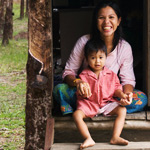
I did my first homestay in Ban Lion on Koh Phratong. The entire village was built after the tsunami in 2004, funded by the Lion Club. It was really a great way to experience the island. The little boy at my host family's house was so adorable I wanted to take him home with me! And the food was outstanding. I thought I was going to explode after eating my farewell lunch!
We went for a "hay ride," Thai-style the afternoon we arrived. We all piled into a flatbed truck and went across Koh Phratong into the savanna. It looked like I could be in the middle of Africa, quite beautiful. We found a land tortoise tucked inside his shell and visited the remains of an old tin mine that had been abandoned. On our way back we saw a bird dive and pick up a live snake for dinner. Then we headed back to the homestay for a fantastic dinner.
 In the morning I was lucky enough to watch the bimonthly N-ACT Network (North Andaman Community Tourism) meeting. It was really exciting to see Nat, the N-ACT Project Manager, in action. We started the meeting and I realized: the people here are N-ACT. 8 villages gathered to discuss the future of the organization that will cease to exist, at least in terms of funding, in the middle of July 2010. We sat under the community school, about 20 feet from a miniature swing set and climbing dome for the kids. Dogs sauntered past, waiting to see if any of the meeting attendees accidentally dropped food. Homestay divas slowly bring a variety of tea, coffee, and snacks to keep us going. The setting is perfectly symbolic of community action.
Then Nat snapped into her element. She introduced the meeting. The issues: the N-ACT Thai website, marketing materials, the network committee, data collection for reporting purposes, and last but not least, the future of N-ACT and ongoing support for all the projects.
 Everyone introduced themselves. I awkwardly said my name. I mostly listened to the intonation because I cannot understand Thai very well. It was so different from the stuffy community meetings I ran in the U.S. People spoke when they thought of something, made jokes that sent the whole meeting into uproarious laughter. Kids yelled and played close by and nobody stopped them or hushed their screams of excitement. It was informal, but direct. There was no lack of business decisions made, but the informality lends itself to intense concentration when a serious subject arose. I never looked around a community meeting in the U.S. and saw every single person making eye contact with whoever was speaking.
I saw how this network actually makes an impact on the individuals at the meeting and in the villages. They are not appointed employees looking out for folks in the village. They are the villages. The decisions made in the meeting are reached with consensus because they directly affect everyone. The network has raised capacity in each person, who has then shared their knowledge with their home town, so that their traditional way of life can be maintained while they earn additional income in various sustainable ways.
 Handicrafts, homestays, weaving nipa palm fronds for roofing material , and graciously showing curious foreigners how they live. Just demonstrating the process of making fish paste, constructing a squid trap, or dressing a guest up in a traditional Muslim outfit can earn a family extra money. These are activities they do every day regardless of tourism. But with the professional training nurtured by N-ACT, villages have started investing in the future by pooling their income and supporting each other to attend marketing and business development trainings. It seems that a few embers of education can spread wisdom like wildfire.
Labels: ecotourism, homestay, N-ACT
Monday, January 18, 2010
Community Network - Profiles from the Field
Alee Salee, Niyom Prai Group, Ton Kloy Village
 Born in a nearby village, Alee moved to Ton Kloy as a young man, and, for many years, supported his family by hunting wild animals. The forests surrounding Ton Kloy are renowned for rare plants, a great diversity of butterflies, and abundant wildlife. Over time, Alee began to understand that it was important “to protect the forest and keep wildlife in this area for people to see in the future.”
While keeping a clear eye on the future, Alee is also addressing the pressing conservation problems of today. Along with other former hunters from Ton Kloy, Alee visits surrounding villages, and asks hunters to refrain from shooting the deer, gaur, serow, and other wildlife that come to Ton Kloy’s fruit orchards for food and water. Alee reports that his efforts have been successful in reducing illegal wildlife hunting; there are no longer any hunters in his village and five hunters from nearby villages have stopped poaching.
When his village formed the “Niyom Prai” conservation group in 2007, Alee was among the first to join. From the onset, the group has worked to develop the area’s ecotourism potential with a focus on jungle hikes, including a spectacular waterfall and an historical tin mine. The Tourism Club also engages in community service activities including trail maintenance, road side clearance, and rubbish removal.
“By successfully preventing hunting and forest encroachment in our village, we can then expand to other villages when they have seen the result,” Alee concludes, “going to hunt a deer we can feed only five or six persons, but if we keep a deer everyone can come and see it for a long time.”
Labels: community tourism, conservation, ecotourism, Ton Kloy
Monday, August 31, 2009
Welcome Aboard!
Experienced Program Manager joins Andaman Discoveries
Claudine Nagiah, UK, has about 10 years of experience with a focus on international development projects and natural resource management. She has been living in Thailand since January 2009, and is planning to be with Andaman Discoveries until November, assisting in the office and on-site at projects.
“My passion is to work in ecotourism and community-based tourism, as it’s an area which I find interesting, varied, challenging and fulfilling. I am looking forward to learning about Andaman Discoveries and Kuraburi, which I hear has some of the best food in Thailand,” said Claudine.
Mimi Cheung, program development manager, said, “Claudine has joined our team at the perfect time. She has extensive knowledge about community development, which will be highly valued as we research new programs to offer our guests. Thank you for being a part of our team, Claudine!”
There are periodic openings for an opportunity to be a part of the AD team. Are you a student or recent graduate eager to gain more hands-on experience? Or are you a professional ready to take a career break, but want to utilize your marketing and business skills? If yes, then Andaman Discoveries wants to hear from you.
Labels: Andaman Discoveries, community-based tourism, ecotourism, international development projects, natural resource management
Thursday, July 16, 2009
Take a Hike ... Up Mae Nang Khaow Mountain!
N-ACT Organizes Pilot Trip
 The North Andaman Community Tourism (N-ACT) Network arranged a light trek up Mae Nang Khaow Mountain with ecotourism specialist Bill Tuffin. The purpose was to determine the viability of the hike as an ecotourism activity for Mae Nang Khaow village. “The route was of high interest, with fascinating things like a large banyan tree. The hike has potential for a tourist activity once the route is improved,” concluded Bill.
The hikers were treated to a peaceful waterfall during the three-hour activity, which bypassed the summit in favor including a local temple. (Venturing further up the mountain could reward more intrepid trekkers with additional waterfalls and a possible sighting of the famous raffleasia flower.)
N-ACT strives to support villagers in the region through activities like the Mae Nang Khaow hike. “The villagers are keen to welcome guests. Pilot tours help us determine areas for potential and for improvement, like points in the hike to explain interesting plants or history. One such point of interest is a big Sai and stone at the ground,” said program manager Nattaya “Nat” Sektheera.
Labels: community tourism, ecotourism, N-ACT, raffleasia flower, trekking
Friday, July 3, 2009
Erik's Adventures - Mangrove Planting in Tung Dap
 From Tung La Ong pier, the departure point from the mainland, the light of dawn shimmered off the dense mist draped over the distant mountains, coating the rainforest with what looked like a rippled layer of icing. Two festively-painted fishing boats idled nearby while women perfunctorily sorted the previous night’s catch. Here I met Nu, my boat driver, a quiet but amiable young man with a shock of jet-black hair that he wears in the rough-cut mullet style currently in vogue in Thai pop culture. With a vigorous crank, our traditional longtail’s engine came to life in a piercing fit, and soon Nu was expertly ferrying us over the tranquil waters of the Andaman Sea towards the southwestern tip of Koh Phratong, home of the fishing village of Tung Dap.
Tung Dap was almost wholly leveled by the tsunami of December 2004, and particularly hard hit were its mangrove swamps. Although the village has since been rebuilt and life has largely returned to normal there, the work of restoring the mangroves, a vital coastal buffer and ecosystem, continues.
We moored the boat just offshore and set upon our first task: retrieving several canvas sacks of mangrove seedlings. With the help of Nu I’d soon added useful new lexis to my budding Thai language skills: nok maak, which means very heavy! Indeed, gravity seemed to increase by an order of magnitude as we plodded through the fine, sediment-rich mud, and before it occurred to me to remove them, the sucking vacuum of each footstep simultaneously claimed both of my 35-Baht flip-flops.
 From there Nu piloted the boat to Tung Dap pier, where we were joined by his wife Pin, as well as Yui and Fen, who’d prepared a savory breakfast of squid in chili sauce, pickled eggs, and fresh vegetables accompanied by white rice -- the foundation of any Thai meal.
With our team now assembled and sated, we leisurely reboarded the longtail and headed inland, navigating our way along a meandering river channel. More than two years after the tsunami, the evidence of destruction is still readily apparent here, with large swaths of denuded land still bearing testament to the wave’s destructive power.
Mangrove seedlings look a bit like unburned candles, varying in length from a few inches to over a foot, and ranging in hues of green similar to those of an avocado. These remarkable seedlings are germinated while still attached to the parent tree, and can produce their own food via photosynthesis. A mangrove seedling often travels great distances by water, and can actually alter its own density depending on whether it needs to float or upright itself to take root. Furthermore, it can survive desiccation and remain dormant for over a year until it arrives at a suitable environment in which to find purchase.
 Using my t-shirt as a basket, I loaded up several handfuls of seedlings and schlepped along the mucky shore. My instructions were simple: lodge each seedling about an inch or two into the ground, and make sure to space them a few feet apart; any seedlings that were missing a “wick” were no good.
In bare feet, I constantly fought to mask the discomfort of traversing the prickly stubble of protruding sticks; I was already failing to keep pace the locals, with their obviously thicker-skinned soles. Three hours and a few scrapes and cuts later, we’d filled vast barren stretches of shoreline with seedlings, greatly facilitating the restoration of the coastal environment.
We then headed to a nearby beach where, with empty canvas sacks in hand, we embarked on our final mission for the day, which was to collect more seedlings. I’d previously assumed the seedlings were farmed or brought in from somewhere (as they are in all other mangrove reforestation programs in the Koh Phratong area), but it turns out they wash up in abundance along the beach -- in an hour we’d filled five sacks of them, which we left on the beach for tomorrow’s crew. I also found two mismatched but functional flip-flops amongst the flotsam and jetsam, greatly easing my trip back to Kuraburi.
Back at sea, Nu stopped the boat and Fen instructed me in English that “now we go swimming.” We playfully splashed around in the Andaman’s saline waters, liberating ourselves of mangrove mud and allowing the morning’s toil to slip away. The resilience of Tung Dap’s people struck me at this moment: from day one they’ve been steadfast in their determination to restore their lives and their village, and in a manner that’s respectful of the natural environment. Innocent laughter reverberated as we took turns hoisting one another into the water. Remarkably, in the face of everything it’s taken from them, the people of Tung Dap are at completely peace with the sea.
Labels: activities, ecotourism, habitat restoration, Hands-on, mangrove planting, tsunami, Tung Dap
Tuesday, June 16, 2009
Erik’s Adventures - Fragile Footing
Can Ecotourism Save the Ban Naa River?
 P’ Lek stares wistfully at the banks of the Ban Naa River, located about 65 kilometers south of Ranong, while he pilots our inflatable raft downstream. On our left is a large concrete tower -- formerly part of a suspension footbridge -- now toppled and half-submerged, enmeshed in a tangle of cables. The surrounding land has all been cleared, stripping its rebar-like root system; recent monsoon rains swept away the tower’s vulnerable footing. Across the river a lone tower stands sentinel amongst dense forest.
Further downstream we anchor at an oxbow where rubber tree saplings cling dearly to the abrupt precipice; this year alone the river’s dimensions at this location have swelled by several meters through erosion. Lek and his team of five villagers set about measuring the damage -- river width and depth -- using rope, a plumb, a tape measure, a length of blue PVC pipe, and a camera. I’m one of several Westerners who have joined them on this rainy day -- including staff from Andaman Discoveries, N-ACT, and the Peace Corps -- to survey roughly three kilometers of the Ban Naa River and assess its eco-tourism potential.
 A few years ago this muddy, silted beach was lined with a protective canopy of native jungle, with an accompanying chorus of high-pitched locusts and birdsong. And as many years ago the mono-crop plantations of rubber and oil palm that now conspicuously abut upon the river were home to varied fruit orchards. A recent drop in fruit prices encouraged the switch from these crops. “I love this area and want to see it restored. I am hoping to use tourism as a tool to re-introduce sustainable agriculture to the area,” Lek told us.
The nickname Lek, which is the Thai word for small, is as incongruous on this imposing forty-something man with a wispy ponytail as his 4X4 racing t-shirt is to his ethos of conservation. His vision is to staunch the degradation of this area and eventually reverse it by reintroducing the cultivation of sustainable mixed agriculture through community-based ecotourism. With tourists paying to harvest fruit, he hopes to make this type of farming financially viable again. In addition, he’s launching youth conservation efforts to educate young people as to the value of conservation.
 At the next stop Lek harvests a few krai nam saplings. These trees have robust root structures, and Lek will re-plant them upstream in areas where the shoreline has been compromised by erosion. By relocating them upstream he also hopes that their seeds will eventually find purchase in soil further down. Such ideas are in stark contrast to the solutions employed by the mono-crop farmers, as I soon learned firsthand. At another stop, we anchor the raft along a desolate shore of dirt and stones. I jumped out of the raft and thought ground had been pulled out from under me – here the river had been dredged with a backhoe, forming a deep channel right up to the shore. This practice requires continual maintenance, and drastically increases silting problems downstream.
To be sure, Lek and his team face an uphill battle. There are powerful, well-financed forces at work in the area whose only concern is quick profits. But the optimism of Lek and his staff is contagious, and combined with the natural beauty of the area one cannot help but feel inspired by his team’s grassroots efforts.
In addition to the rafting trip, the area offers attractive ecotourism opportunities such as a short hike to a hot/cold spring and an overnight hike to the La Ong Dao waterfall. The village of Ban Naa also offers visitors the opportunity to engage with the monks of a forest temple and the chance to learn from local artisans whose handicrafts include weaving and making rattan furniture.
For more information about Ban Naa, please contact Nat at info@andamancommunitytourism.com
Labels: agriculture, conservation, ecotourism, erosion, mono crop, rafting, sustainability
Subscribe to Posts [Atom]